
Food Processing Is Essential to Agriculture – Changing the 50-50 Rule in BC
Food Processing Is Essential to Agriculture – Changing the 50-50 Rule in BC
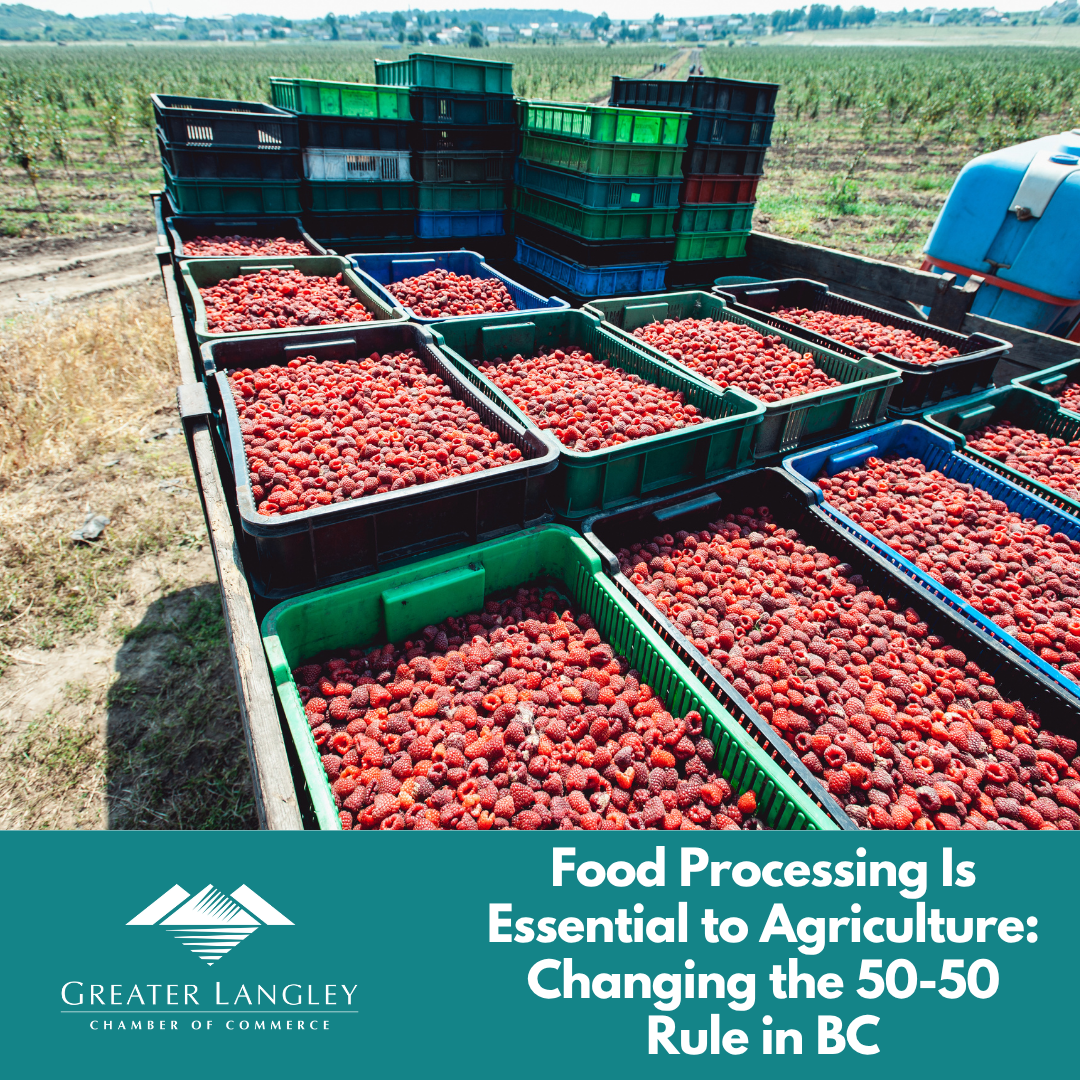
Food processing is essential to agriculture.
For BC food to reach customers, farmers and food businesses need the infrastructure to wash, pack, store, process, prepare, and bring products to market. However, BC’s current 50-50 rule limits what food products can be processed in a facility located on Agricultural Land Reserve land. Since the rule came into effect in 2002, it has contributed to lost processing capacity and made it harder for new facilities to open. That weakens BC’s food security and limits opportunities for farmers and food businesses.
The BC government is now consulting on a proposed change to this rule.
At a time when BC needs to strengthen local food systems, diversify supply chains, and expand export opportunities, the Langley Chamber sees this proposal as an important step for agriculture businesses. We are encouraging the Province to modernize the 50-50 rule and create a more practical pathway for food-processing facilities on lower-capability ALR land.
The Current Rule:
In simple terms, the 50-50 rule generally means a food-processing facility on ALR land has to source at least 50% of its product from the same farm property where the facility is located. That works for small farm-based processing, but it can limit shared or larger processing facilities because they cannot easily use ingredients from other farms, operate year-round, or grow beyond what one property can produce.
Think of a lettuce farm that wants to package a salad mix but it does not grow carrots, radishes, or herbs. Under the 50-50 rule, bringing in those ingredients from other farms could put the facility offside, requiring special permission even though the final product is still a local BC farm product.
The current rules make it difficult for local producers and agri-food entrepreneurs to build processing capacity close to the farms they serve. Too often, they are pushed toward expensive industrial land or limited by rules that tie processing to what can be grown on one farm property, despite the seasonal nature of crops and the need to source from multiple farms. As a result, some BC food leaves the province as raw product, only to be processed elsewhere and return as finished food or agri-food products.
The Change:
The proposed regulatory change would allow food-processing plants to be built on Class 5–7 land in the ALR (and on Class 4 parcels that are already serviced) provided at least 5% of the primary product used in processing is grown or raised in the province.
Roughly 90% of ALR farmland in the Lower Mainland and Fraser Valley would remain ineligible under the proposal. Of the land that would qualify, government estimates 500 to 1,000 hectares could become available for food-processing development.
Classes 5–7 are the non-arable classes, land that cannot sustain cultivated crops, though it can support forage, grazing, hay, and certain specialized crops. That is what makes it the right land for this purpose: it puts buildings where crops cannot go. Nothing in this proposal prevents that land from continuing to be farmed; it simply creates a limited pathway for lower-capability land to also support processing capacity.
The proposed 5% rule is meant to ensure food-processing facilities still have a connection to BC agriculture, while allowing processors to source more broadly than being tied to the output of one farm property. That broader sourcing ability could help facilities operate at scale and throughout more of the year. The 5% level is a low bar and may warrant further consideration by government to ensure processing ends up serving BC farms and crops, but it is a critical piece of the reform nonetheless.
More processing capacity can create new markets for farmers, support farm expansion, attract investment, create jobs, and keep more of the value of BC-grown food here in the province. Without adequate processing infrastructure, farmers have fewer options, food businesses face higher costs, and BC’s food system becomes more vulnerable to disruption.
Input Opportunity:
The Province is now seeking feedback on this proposal, and we encourage farmers, food processors, agriculture businesses, local governments, and community members to participate. Now is the time to share your perspective on this issue.
Read the discussion paper here, and feedback can be sent directly to the Province before September 18 at: AF.Minister@gov.bc.ca
The Chamber would welcome your input or thoughts as well at: cory@langleychamber.com